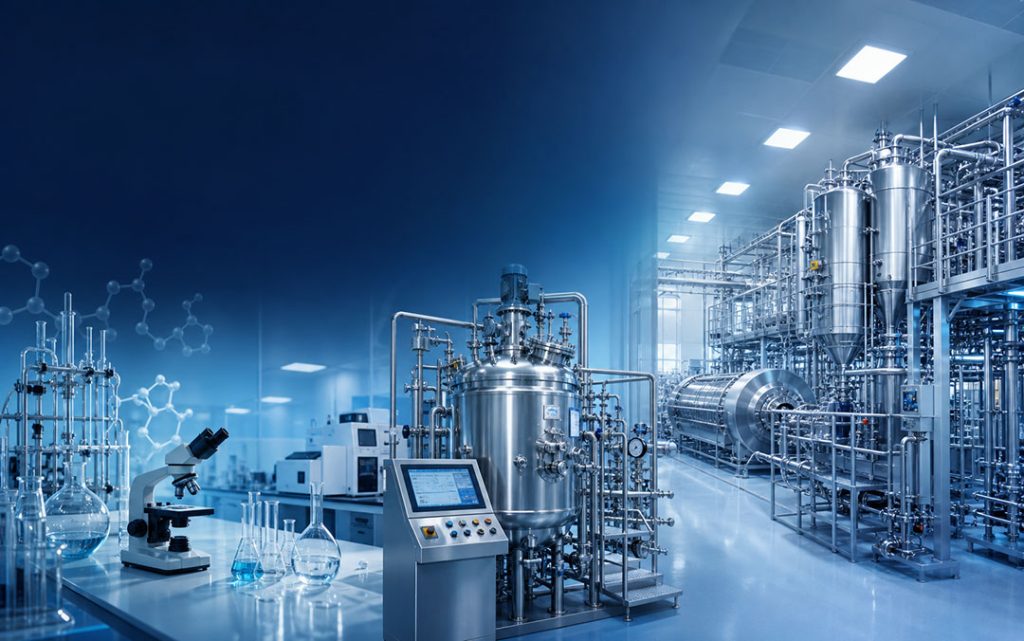
API Manufacturing Process: From Laboratory Research to Commercial Production
The development of an Active Pharmaceutical Ingredient (API) is far more complex than performing a series of chemical reactions. Before an API becomes part of a finished pharmaceutical product, it must pass through multiple stages of scientific research, process optimization, pilot manufacturing, and industrial-scale production.
Modern pharmaceutical manufacturers combine scientific expertise, engineering capabilities, and internationally recognized quality systems to ensure that every API is produced consistently, safely, and efficiently.
Understanding the API manufacturing process highlights the critical role of research, quality management, and continuous process improvement in today’s pharmaceutical industry.
What Is the API Manufacturing Process?
The API manufacturing process is a structured sequence of scientific and industrial activities that transforms a laboratory-developed compound into a pharmaceutical-grade active ingredient suitable for commercial drug manufacturing.
The process generally includes:
- Research & Development (R&D)
- Synthetic route design
- Laboratory-scale synthesis
- Process optimization
- Pilot-scale manufacturing
- Commercial production
- Quality Control (QC)
- Quality Assurance (QA)
Each stage contributes to producing APIs that meet regulatory and quality expectations.
Stage 1: Research & Development (R&D)
Every successful API begins with research.
During this phase, scientists evaluate:
- Molecular characteristics
- Synthetic pathways
- Raw material selection
- Reaction efficiency
- Impurity reduction strategies
The objective is to establish a manufacturing process that delivers both high product quality and industrial feasibility.
Stage 2: Process Development and Optimization
Once an initial synthesis pathway has been selected, the process must be optimized for industrial application.
Optimization focuses on improving:
- Reaction yield
- Production efficiency
- Solvent selection
- Energy consumption
- Manufacturing cost
- Process safety
Well-designed process development creates a strong foundation for commercial manufacturing.
Stage 3: Laboratory Manufacturing
Laboratory-scale production verifies that the proposed manufacturing process performs as expected.
This stage allows scientists to:
- Confirm synthesis performance
- Evaluate API purity
- Identify impurities
- Generate analytical data
- Assess process reproducibility
The collected information guides further development activities.
Stage 4: Pilot-Scale Manufacturing
Pilot production bridges the gap between laboratory research and full-scale manufacturing.
Its objectives include:
- Evaluating process scalability
- Testing industrial equipment
- Identifying operational challenges
- Estimating manufacturing costs
- Verifying production stability
Successful pilot studies significantly reduce commercial manufacturing risks.
Stage 5: Commercial Manufacturing
Following successful pilot validation, production moves to full industrial scale.
Commercial API manufacturing typically involves:
- Large-scale reactors
- Automated process control systems
- Industrial filtration equipment
- Drying technologies
- Controlled packaging operations
The primary objective is to manufacture pharmaceutical ingredients with consistent quality across every production batch.
Quality Control Throughout the Manufacturing Process
Quality Control (QC) is integrated into every stage of API production.
Routine testing evaluates:
- Chemical purity
- Impurity profile
- Stability
- Physical properties
- Compliance with product specifications
Continuous quality monitoring helps ensure product consistency and regulatory compliance.
The Importance of GMP in Industrial API Manufacturing
Commercial API production must comply with Good Manufacturing Practice (GMP) requirements.
GMP supports:
- Product consistency
- Batch traceability
- Manufacturing reliability
- Documentation integrity
- Patient safety
Maintaining GMP compliance is essential for pharmaceutical manufacturers operating in regulated markets.
Continuous Improvement Through Research & Development
Process development does not end after commercial launch.
Modern pharmaceutical companies continue investing in R&D to:
- Improve manufacturing efficiency
- Increase reaction yields
- Reduce production costs
- Enhance product quality
- Introduce advanced technologies
Continuous improvement helps manufacturers remain competitive in the global pharmaceutical industry.
Imagen’s Process-Oriented Approach to API Manufacturing
Reliable pharmaceutical manufacturing requires more than advanced equipment—it depends on scientific expertise, disciplined process management, and a commitment to continuous improvement.
At Imagen Pharma, process development is supported by technical knowledge, quality-focused manufacturing principles, and ongoing investment in scientific capability.
Key priorities include:
- Continuous process optimization
- Research-driven development
- Manufacturing excellence
- Quality-focused production
- Sustainable industrial growth
This long-term approach contributes to stronger operational performance and supports future pharmaceutical innovation.
The Future of API Manufacturing
The pharmaceutical industry is rapidly adopting advanced manufacturing technologies.
Future API production will increasingly rely on:
- Green Chemistry
- Continuous Manufacturing
- Artificial Intelligence
- Smart Manufacturing Systems
- Advanced Process Analytics
- Industrial Digitalization
These innovations are expected to improve manufacturing efficiency, product quality, and long-term sustainability.
Conclusion
The API manufacturing process is a highly structured journey that begins with scientific research and continues through process development, pilot manufacturing, industrial production, and continuous quality improvement.
Organizations that invest in scientific expertise, process optimization, GMP compliance, and innovation are better positioned to deliver reliable pharmaceutical ingredients while strengthening their competitive advantage.