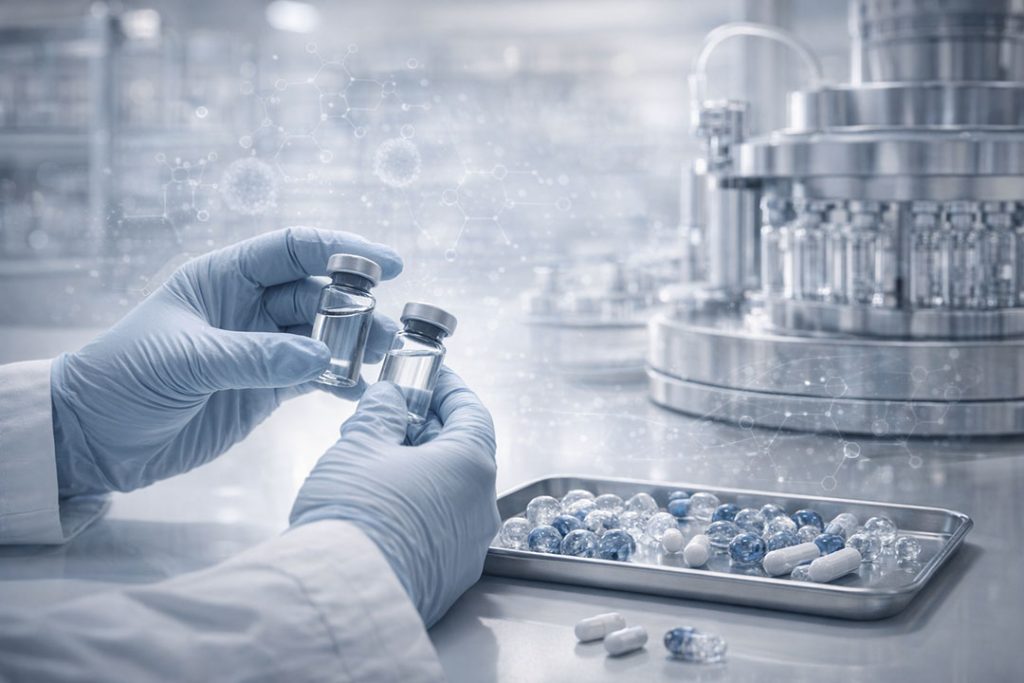
The pharmaceutical industry has always been driven by scientific innovation, and one of the most transformative technologies in recent decades is nanotechnology. By manipulating materials at the nanometer scale, researchers and manufacturers can improve the physical, chemical, and functional properties of pharmaceutical ingredients.
Today, nanotechnology in pharmaceuticals plays an increasingly important role in the development of next-generation Active Pharmaceutical Ingredients (APIs). Beyond drug formulation, nanotechnology contributes to process optimization, improved manufacturing efficiency, and the creation of innovative pharmaceutical products capable of meeting future healthcare challenges.
What Is Nanotechnology in the Pharmaceutical Industry?
Nanotechnology involves the design, manipulation, and application of materials with dimensions typically ranging between 1 and 100 nanometers.
Within pharmaceutical manufacturing, nanotechnology is applied to improve:
- API performance
- Material stability
- Manufacturing efficiency
- Drug delivery technologies
- Product consistency
These innovations help pharmaceutical companies develop safer, more efficient, and higher-quality products.
Why Is Nanotechnology Important for API Development?
Developing new Active Pharmaceutical Ingredients often involves overcoming challenges such as poor solubility, limited stability, and complex manufacturing requirements.
Nanotechnology offers advanced scientific solutions that can help improve these characteristics while supporting more efficient production processes.
Key benefits include:
Improved Physical Characteristics
Nano-engineered materials can provide:
- Better particle size control
- Increased surface area
- Enhanced material performance
- Improved manufacturing consistency
Greater Stability of Pharmaceutical Compounds
Certain pharmaceutical compounds are highly sensitive to environmental conditions.
Nanotechnology can help improve stability during manufacturing, storage, and transportation, contributing to more reliable pharmaceutical products.
Process Optimization
Modern nanotechnology enables manufacturers to achieve more precise control over production parameters, supporting:
- Improved manufacturing efficiency
- Better process reproducibility
- Higher product quality
- Reduced manufacturing variability
Innovation in Pharmaceutical Products
Nanotechnology continues to support the development of innovative pharmaceutical solutions by enabling researchers to explore new material structures and advanced manufacturing concepts.
Applications of Nanotechnology in API Manufacturing
Nanotechnology is increasingly being integrated into different stages of API development, including:
- Advanced material engineering
- Process optimization
- Particle size control
- Manufacturing efficiency improvement
- Development of innovative pharmaceutical technologies
These applications contribute to higher-quality pharmaceutical ingredients and more efficient industrial production.
The Relationship Between Nanotechnology and Research & Development (R&D)
Many breakthroughs in pharmaceutical nanotechnology originate from strong Research & Development programs.
Continuous investment in R&D supports:
- Development of new technologies
- Process innovation
- Scientific knowledge expansion
- Advanced pharmaceutical manufacturing
For pharmaceutical manufacturers, innovation and nanotechnology are closely connected.
Nanotechnology and Pharmaceutical Quality Standards
The adoption of advanced technologies must always be supported by robust quality systems.
Successful implementation requires compliance with internationally recognized standards, including:
- Good Manufacturing Practice (GMP)
- Quality Control (QC)
- Quality Assurance (QA)
- Manufacturing documentation
- Product safety evaluation
Combining innovation with quality management ensures that technological advances translate into reliable pharmaceutical production.
Imagen’s Innovation-Oriented Perspective
Innovation has become one of the key drivers of long-term competitiveness in pharmaceutical manufacturing.
At Imagen Pharma, continuous scientific development, process optimization, and investment in technical expertise support a forward-looking approach to API manufacturing.
This development-oriented strategy emphasizes:
- Research-driven innovation
- Continuous improvement
- Manufacturing excellence
- Scientific capability development
- Sustainable pharmaceutical growth
Such an approach strengthens long-term competitiveness while supporting the evolution of pharmaceutical manufacturing.
Future Trends in Pharmaceutical Nanotechnology
The global pharmaceutical industry is expected to increase its investment in nanotechnology over the coming years.
Key emerging trends include:
- Nano-engineered pharmaceutical materials
- Smart manufacturing systems
- Artificial Intelligence-assisted development
- Sustainable pharmaceutical technologies
- Precision manufacturing
- Green production processes
These innovations are expected to shape the next generation of pharmaceutical manufacturing worldwide.
Conclusion
Nanotechnology has become one of the most promising technologies driving innovation within the pharmaceutical industry.
Its applications in Active Pharmaceutical Ingredient development contribute to improved manufacturing processes, enhanced product quality, greater scientific capability, and long-term industrial competitiveness.
As pharmaceutical technology continues to evolve, integrating nanotechnology with research, quality management, and advanced manufacturing will play an increasingly important role in developing next-generation pharmaceutical solutions.